
Long before highways stitched the Midwest together, iron rails carried people, goods, and ideas across the American landscape. Few communities were more deeply shaped by that era than Burlington, Iowa. Perched along the Mississippi River, Burlington became a critical junction where river traffic met the expanding railroad network, transforming a young frontier town into a powerhouse of commerce and innovation. Today, traces of that railroading legacy remain woven into the city’s stories, offering travelers a fascinating window into a pivotal chapter of American history.
Burlington’s railroad story begins in the mid-19th century, when the city was already thriving as a river port. The Mississippi served as the main artery of trade, but as the nation pushed westward, railroads promised faster, year-round transportation that was not dependent on river levels or seasonal freezes. Burlington’s leaders recognized early that rail access would be essential to the city’s future. Their vision paid off in 1856, when operations of the Burlington and Missouri River Railroad began in the city, creating a vital east west link between the Mississippi River and the developing interior of Iowa and beyond.
This rail connection placed Burlington at the center of a rapidly growing transportation network. Freight cars loaded with grain, livestock, lumber, and manufactured goods rolled through the city, while passenger trains carried settlers, entrepreneurs, and travelers eager to explore new opportunities in the Midwest. Burlington quickly became known as a railroad town, where the sound of whistles and the rumble of trains were part of daily life.
One of the most influential chapters in Burlington’s railroad history came with the rise of the Chicago, Burlington and Quincy Railroad, often referred to simply as the CB&Q. Headquartered in Burlington for many years, the CB&Q was one of the most important railroads in the nation, operating thousands of miles of track across the Midwest and Great Plains.
The presence of the CB&Q brought jobs and prosperity. Burlington became home to skilled engineers, conductors, machinists, and clerks, many of whom built lasting roots in the community. The railroad also drove advances in technology and efficiency, contributing to Burlington’s reputation as a forward-looking city during the height of the rail era.
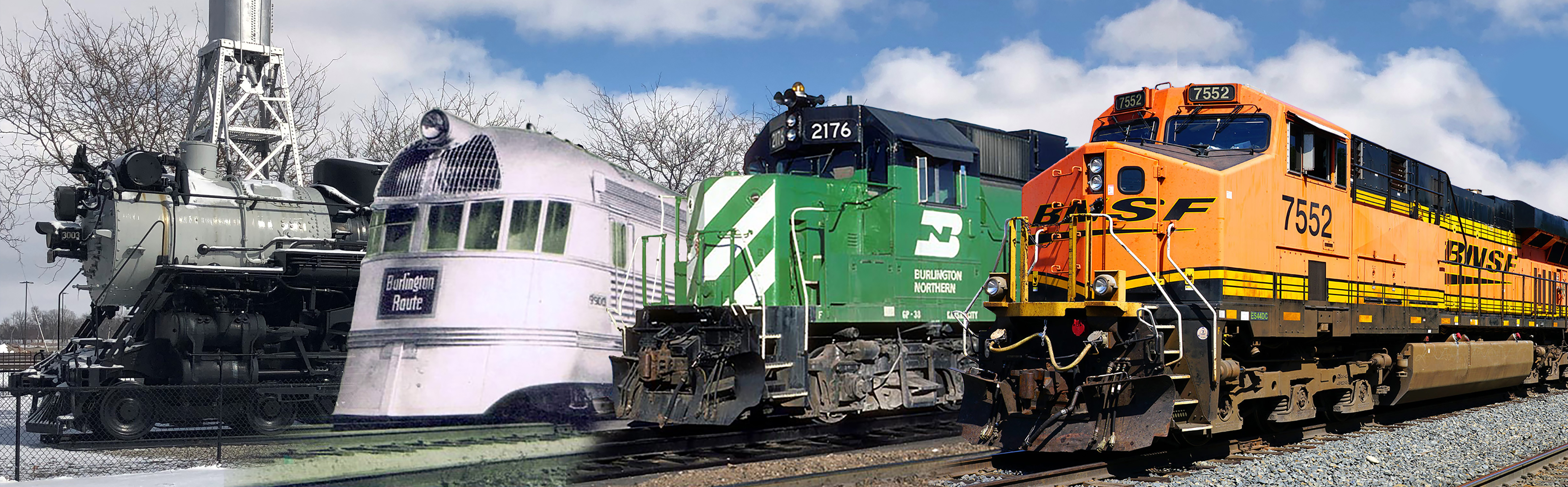
A major turning point in Burlington’s railroad story came in 1970 with the formation of the Burlington Northern Railroad. This new rail giant emerged from the merger of several historic lines, most notably the CB&Q, the Great Northern Railway, the Northern Pacific Railway, and the Spokane, Portland & Seattle Railway. For Burlington, this merger marked both an end and a beginning. While the familiar CB&Q name faded into history, its legacy lived on through Burlington Northern, which carried forward Burlington’s deep connections to rail commerce.
Burlington Northern quickly became one of the largest rail systems in North America, operating tens of thousands of miles of track across the Midwest, Great Plains, and Pacific Northwest. Although corporate headquarters and operations became more centralized, Burlington remained a symbolic birthplace of the system, rooted in the influence and infrastructure of the CB&Q. Trains continued to roll through the city, carrying agricultural products, manufactured goods, and raw materials that powered regional and national economies. The sight of green Burlington Northern locomotives crossing the Mississippi became a new visual chapter in a story that stretched back more than a century.
Another transformative moment arrived in 1995, when Burlington Northern merged with the Atchison, Topeka and Santa Fe Railway to form Burlington Northern Santa Fe, now known simply as BNSF Railway. This merger created one of the most powerful freight rail networks in the world, linking Burlington’s rail heritage to global supply chains and modern logistics. Today, BNSF trains passing through Burlington represent the evolution of railroading from the steam and diesel eras into a high efficiency, technology driven industry that remains essential to American commerce.
Travelers interested in experiencing Burlington’s railroad heritage firsthand have several meaningful places to explore. A visit to the Des Moines County Heritage Center provides valuable context, with exhibits that highlight local transportation history. South of downtown, visitors traveling north on Main Street can catch a glimpse of the BNSF rail yards along the riverfront. Also on Main Street, just north of the Burlington Train Depot, visitors can take in a stunning example of a steam locomotive from the Burlington Route.
Today, Burlington invites travelers to slow down and reflect on the journeys that built the Midwest. Whether you are a history enthusiast, a railfan, or simply curious about the forces that shaped America’s heartland, Burlington offers a rich and authentic railroad story waiting to be discovered. Standing beside the tracks or overlooking the river, it becomes clear that the rails did more than move trains. They carried Burlington into history and helped define the community it is today.
Burlington, Iowa Virtual Railfan Livestream